nginx in Production
Reverse Proxy, TLS, and High-Traffic Operations.
Planned
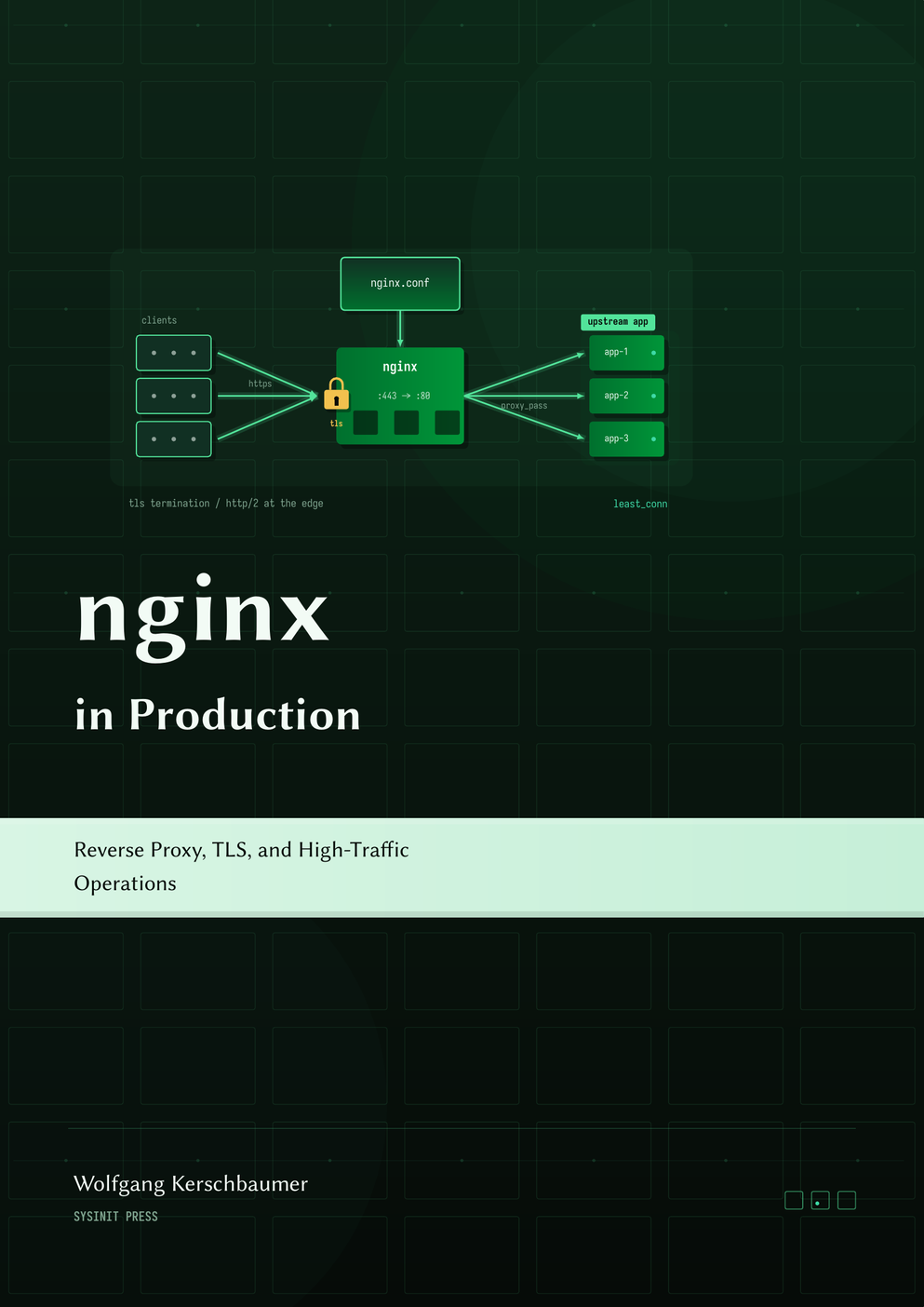
nginx sits between the network and the application servers behind it. Each request passes through its configuration model, which picks a server and a location block and applies the directives that inherit into them. This book will cover that path in production: how proxying and upstreams move requests to backends, how TLS is terminated and kept current, how caching and rate limits absorb load, and how a busy instance is tuned and reloaded without dropping connections.
Status: planned title. Writing has not started. The repository and the cover exist; the scope below is the plan.
The first edition will ship DRM-free as PDF and EPUB, with free updates.
Reader poll Readers pick which Sysinit Press title we finish next. nginx in Production is on the ballot.
Vote for this bookThe proxy layer, end to end.
No chapters are written yet. This is the plan: the areas the book will cover, in the order a reader would meet them. It targets current stable nginx on Linux.
- The configuration model How nginx selects a server and location for each request, and how directives inherit across contexts.
- Reverse proxying and upstreams proxy_pass semantics, upstream pools, load balancing, and retry and failover behavior.
- TLS termination Certificates and automated renewal, protocol and cipher configuration, and session resumption at the edge.
- Caching proxy_cache setup, cache keys and validity, and serving stale content while a backend recovers.
- Traffic control Rate and connection limits, request buffering, and keeping bursty clients away from the backends.
- Tuning and operations Worker and connection settings, kernel limits, zero-downtime reloads and upgrades, and the logs and metrics that show what the proxy is doing.
For engineers who put nginx in front of real traffic.
This book is for people who run or evaluate nginx as a reverse proxy. It assumes comfort with the command line and basic HTTP concepts, and it explains the nginx model rather than listing recipes.
- Platform and infrastructure engineers placing nginx in front of application servers, who want to understand what the proxy does to each request.
- Operators already running nginx who want a clear model of directive inheritance, request matching, and upstream behavior rather than a set of snippets.
- Teams terminating TLS at the edge who need certificates, reloads, and rate limits to be routine parts of operating the site.
Planned.
Join the shared Sysinit Press book list. You'll get one message when writing on this book starts, plus release news when it ships. The first edition will include DRM-free PDF and EPUB files with free updates.
The signup uses double opt-in. Every message includes an unsubscribe link.